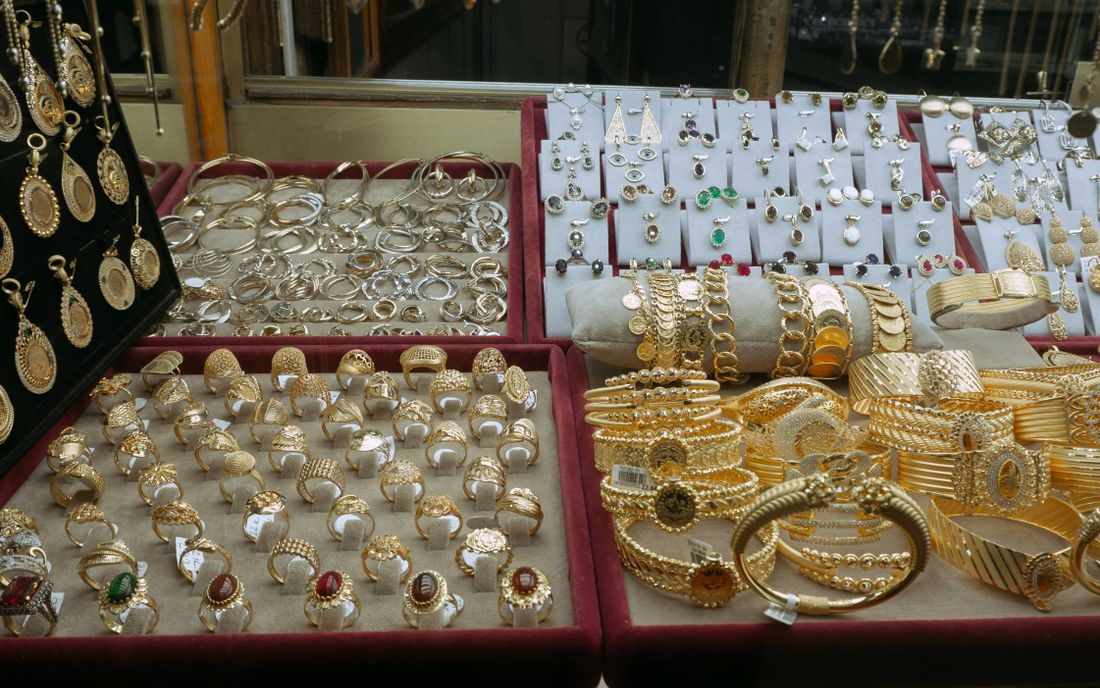
Recounting in a jewellery shop: grams, purity and security
Jewellery is checked twice, in pieces and in grams: set up the scales and count tray by tray with at least two people present.
In a jewellery shop the goods are very small but very costly. The price of one ring may equal a whole shelf in an ordinary shop, so even "one missing piece" makes a big difference here. A recount in such a shop differs from others in two ways: the goods are counted by the piece and by the gram, and the process itself runs under strict security rules.
The unit: pieces and grams together
A jewellery label usually carries the article number, the purity mark (how pure the precious metal is), the weight, the size and details of any stone. In the books each item is kept in pieces and in grams. So the count has two parts: first the number of pieces, then the total weight. Checking only one is not enough. If the piece count is right but the weight differs, items may have been swapped or a label filled in wrongly.
Example: the books show 48 pieces on one tray, 152.40 g in all. The count also finds 48 pieces, but the scales read 151.95 g. The difference is 0.45 g. Compare the weights on the labels with the weighing result: one ring is labelled 3.60 g but weighs 3.15 g. So a stone has fallen out of the ring, or the label belongs to another ring. There is no difference in pieces, yet a real problem has been found.
Pairs, sets and chains
Earrings are counted in pairs: write "1 pair", not "2 pieces", and mark a lone earring separately. If a set (ring, earrings, pendant) is listed whole in the books, check each part: often one part is sold while the rest stays in the showcase. For chains the length defines the position too, as a 45 cm and a 50 cm chain weigh differently.
Scales and labels
The scales on count day should be the same and reliable: checked beforehand, zeroed and not changed during the count. Test them with a check weight. Agree in advance the permitted difference between the label weight and the weighing result, for instance up to 0.05 g, and write it on the sheet. An item that exceeds the limit goes on a separate row.
An item with no label, or with a torn or unreadable one, is marked on the list as "unlabelled". Identify it by weight, hallmark and article number against the books; never write a label at random.
Security: two people, camera, one tray
In a jewellery shop at least two people take part in the count. The salesperson in charge of a showcase should not count their own trays: another employee or an outside counter does, while the salesperson stands by and confirms. The process takes place in view of the cameras. Phones and bags stay away from the table.
On count day the keys to the showcases and the safe are held by the responsible person. A signature goes on the sheet every time a tray is issued and returned. Items kept in the safe overnight are counted in the morning, before trading starts.
Items outside the shop and items that belong to others
A jewellery shop always has items that are not in the staff's hands:
- items a customer took away to look at and has not yet brought back;
- items sent to the workshop for repair or resizing;
- a customer's own item accepted for repair, which does not belong to the shop;
- items taken on consignment from a manufacturer.
Each category must be on a separate list: the name of the item, its weight, who took it and when. A customer's item is never added to the shop's balance, and the whereabouts of every listed item must be known on count day.
Difference in pieces and difference in grams
In jewellery a difference in pieces cannot be tolerated: a missing piece is checked at once, establishing from which tray, when and on whose shift it vanished. A small difference in grams may come from scale error, a fallen stone or a label mistake. Keep the two kinds of difference in separate lists and treat them with different strictness.
Conclusion
Counting in a jewellery shop rests on a double check in pieces and grams, strict security and a list of items outside the shop. The Pereuchet team counts a jewellery shop in a two-person routine, tray by tray, shows differences in pieces and grams and hands over the result as a file for Excel or 1C.